
Video of tourists leaving a historical site in Egypt
January 26, 2019. Written from New York following my trip
Dear Friends and Family,
The above video is a reminder of walking the gauntlet each time we entered or left an ancient site as the venders would try to encourage us to spend our money on their merchandise. “A $Dallar’ a $dallar, a $dallar” they would say as they put copies of ancient cat amulets, Nefertiti in plaster, or painted scarabs under your nose for the friendly “tourist ” to purchase. As some of our group discovered, the $dallar became $10.00 quickly if you stopped and then they wanted you to enter their shop for more fantastic items for sale. Needless to say that with our tight schedule, we resisted the temptations.
The young children who rushed to the bus each time we stopped were even harder to resist. But after hearing our last presenter who talked about the social conditions of Egypt, I am sorry that I resisted, especially the children.
According to the Professor from Cairo University, Egypt has four levels of economic society…the very, very, very, rich…the very rich…the middle class, then the very, very poor. This last category is about 57-60% of the population. They have more than 80% of the children and are living on about $2.00 per day of income. I’m not sure exactly where the agricultural community fit into this mix, but we were told that each family in rural areas had 5 acres to farm and to increase your farm, your daughter or son had to marry into the family next door.
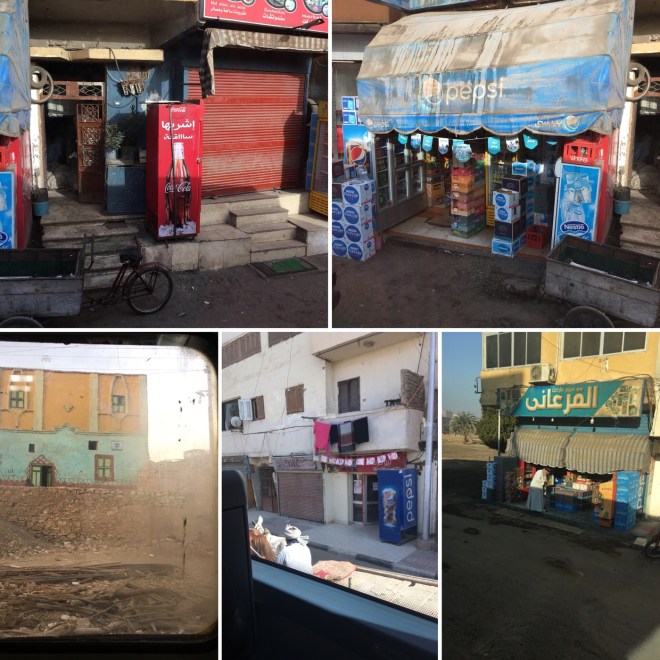
We saw evidence of poverty in the cities and in the country side. Transportation in the country is still by donkey or vintage motor cycle and goods going to market or to the processing plant are transported in flat carts pulled by 40 year old tractors or pickups. Some produce was carried by a single donkey led by a young boy or the farmer himself.
Many houses in both the city and country side were for the most part unfinished. Windows were only in the lowest floor unless that floor was used to house your old truck or animals. The original structure was 4 to 5 stories in height made of brick with openings left for future windows on each floor. Only the occupied floors had windows. When the size of the family increased, additional floors would be finished. Some of the buildings reminded me of houses in Peru with the top unfinished floor used to house the washing and an outside sitting area surrounded with brick columns and rebar ready for another floor. The cost for finishing a floor is around $10,000 but the penalty for not completing your building is only $100 per year.
Egypt is a government subsidized society. Medicine and education are free, ancient, historical and religious buildings and sites are run by the government but the economy is slowing down as it depends heavily on tourism which has declined in recent years due to terrorism. An Egyptian 5 pound note is less than a dollar and the one pound coins are not circulated as they cost more to manufacture than they are worth.
I don’t know what the answer is to this problem, but it is easy to see that it will take greater minds than mine to provide a solution. I can only hope that this solution will come soon. I found that the people we met were friendly and happy that we came and wanted us to come again, soon. With the new Greater Egyptian Museum and a decline in terror activities, improvement may be part of the future of Egypt.
(I will add photos to this blog when I get to a computer to download by camera photos. I only have the photos from my iPhone to use at this time)
Ellen
 Ellen’s Travel Journal 2016-2025